Creosote Bush in Bloom
Photo by Kathy LaShure
Creosote Ring Sub-Chapter
The Creosote Ring subchapter was formed in the Fall of 2005. Our members live in the Indian Wells Valley at the southern end of the Bristlecone Chapter’s geographically large territory.
Events
Meetings
NOTE: Since the previous Creosote Ring Leader (Kathy LaShure) moved from the area at the end of 2016, no one that we know of in the main Bristlecone Chapter has stepped in to organize the Creosote Ring Sub-Chapter in her absence. If anyone has updates, please contact the webmaster at webmaster@bristleconecnps.org and I will update this page.
When we have meetings, we usually meet on the first Wednesday at the Maturango Museum (100 E. Las Flores, Ridgecrest) at 7 pm. Sometimes we have a speaker/program; other times we work on projects and plans (including field trips in our area). Contact the museum to see if there is anything planned.
Field Trips and Events
Below are some of the Bristlecone Chapter and other field trips that are farther south - check the main events page to see more!
 February 8, 2024, Thursday, 12-4 pm: Bristlecone Chapter Website Work Party, Bristlecone Chapter Event
-
We are having a website work party with pizza at White Mountain Research Center to make some coordinated progress on our new WordPress website. If you have any experience with WordPress, please join us, and let us know so we will have enough pizza. Bring your laptop.
- February 12, 7-8:30 pm: California Water Culture; an overview of how California’s unique waterways have been transformed, how it happened, and what it means. North San Joaquin Valley Chapter WEBINAR with Tina Donelly
-
This talk will overview the ties between California’s culture and how it revolves around water & its plants and how the relationship has evolved over the past couple hundred years. Can California balance the needs of the citizens, the landscape, and the economy? This question may not be answered in this talk but insights and realistic perspectives will be given and discussed that may help open a productive dialogue.
Tina has lived in California’s Central Valley most of her life and has been in the Natural Resources Management field for over ten years Please register for this meeting at https://cnpsorg.zoom.us/meeting/register/tZYrdeurpjotG9zydgLLOHRvz56vC2Yes7qx
- February 13, 6-8 pm: How to Garden for Birds in the Owens Valley
-
This workshop will cover why you would want to attract birds to your yards and gardens, the benefits of having birds, what types of habitat you can create for birds, and how this helps the overall health of our planet.
Speakers Jen Pauldi, an environmental scientist, currently working with the Wild Farm Alliance, and Rosie Howard, a UC Master Gardener and Birder, will show you how to create great habitats for our local birds in small and large spaces. They will also introduce you to some local birds and populations that are increasing or declining.
Please RSVP to ensure seating by calling 760-873-7845
- February 15: March-April Bristlecone Chapter Newsletter Deadline
-
Today is the deadline for submissions for the March-April Bristlecone Chapter Newsletter to our Newsletter Editor, Elaine Chow, at newsletter@bristleconecnps.org. Contact Elaine with any questions.
- PROGRAM DATE CHANGED FROM March 27 TO APRIL 3, Wednesday, 7-8pm: Evening Program: Considerations when Designing a Native Plant Garden, at White Mountain Research Center, North Classroom, Bristlecone Chapter Event
-
Please join us on April 3rd, the new date for this program.
- April 19-21, Friday-Sunday: Owens Lake Bird Festival
-
Since 2015, Friends of the Inyo’s Owens Lake Bird Festival in Lone Pine, CA has been celebrating the migration of thousands of birds as they alight at Owens Lake to replenish their strength before continuing their transcontinental journey along the Pacific Flyway, which extends from Alaska to Patagonia. Owens Lake has been designated a Nationally Significant Important Bird Area by the National Audubon Society and the American Bird Conservancy. This Festival is more than just about birding, and outings are designed to cover topics that include botany, photography, geology, local history and culture, and more to complement the experience. To find out the scheduled activities and register, go to: https://friendsoftheinyo.org/birdfestival/
- April 27, Saturday, 9:30am: Chalk Bluff and Fish Slough. Bristlecone Chapter Field Trip with Steve Matson
Meet behind (southside) of Von’ gas station at 9:30 AM.
We will be driving on dirt roads so plan accordingly. No high clearance necessary. BLM Spring in Fish Slough will be our ultimate destination. You may car pool here if you so desire. Driving distances out of Bishop will be short, roughly 30 miles round trip.
Bring lunch, water, sun protection, cameras. There will not be a lot of walking. If time allows, we can practice using iNaturalist app on your smart phone.
The plan is to witness the spring flora near the Owens River north of Bishop and have a look at a species of plant only recently found in California.- May 4, Saturday, 11-2: Native Plant Sale at ESLT Gardenfest, Bristlecone Chapter and Eastern Sierra Land Trust Event
-
A fun family-friendly community event to celebrate spring with Eastern Sierra Land Trust, right in the office’s backyard. Purchase native plants, learn gardening tips and tricks, and enjoy local food and kids activities and more. GardenFest will also offer opportunities to learn about ESLT’s Eastside Pollinator Garden Project, which is helping local gardeners bring their gardens to life by attracting hummingbirds, butterflies, and other important pollinators. Held at 250 North Fowler in Bishop.
- NEW DATE: MAY 5, SUNDAY, 8:30 am: Eureka Valley and Lime Hill. Bristlecone Chapter Field Trip with Steve Matson
-
Meet at 8:30 AM at the kiosk in Big Pine at the Junction of Hwy 395 and Hwy 168. You may carpool here if you care to.
We will be driving on paved roads only, expect about a 60 miles round trip.
Bring lunch, a lot of water, sun protections, cameras.
We will explore a few spots on the way to Eureka Valley and drive no further than the end of the pavement. We hope to find a recently described species in the genus Nemacladus, everyone’s favorite! - May 18, Saturday, 9 am: Weeds and Wildflowers of Swall Meadows. Bristlecone Chapter Field Trip
-
Meet at 9 AM in the gravel pit off of Sky Meadow Road in Swall Meadows.
Leaders: Stephen Ingram and Karen Ferrell-Ingram.
Join in a slow walk out the Sand Canyon road to see the local weeds and wildflowers of the Sherwin Slope. We will learn about invasive weeds of the area and also enjoy the many wildflowers and shrubs in bloom. We can expect to see Silvery Lupine, Lone Pine Beardtongue, and the fearsome Porcupine Prickly-pear, among other beauties. The walk will be a moderate stroll over a rocky dirt road lasting approximately two hours.
Contact Karen Ferrell-Ingram for more information. - June 1, Saturday: Pollinator garden tours, ESLT and Bristlecone Chapter Event
-
Pollinator garden tours starting at the Eastern Sierra Land Trust Office at 250 N. Fowler in Bishop. Locals across the Eastern Sierra have been hard at work creating beautiful native plant and pollinator gardens. During the Garden Tour, you can see these lovely gardens in bloom, and learn more about pollinator-friendly gardening.
- June 15: July-August Bristlecone Chapter Newsletter Deadline
-
Today is the deadline for submissions for the March-April Bristlecone Chapter Newsletter to our Newsletter Editor, Elaine Chow, at newsletter@bristleconecnps.org. Contact Elaine with any questions.
- CANCELED July 15, Saturday, 10am-4pm: Upslope and into the sky: alpine plant communities and climate change in the
White Mountains, CA, Bristlecone Chapter Event, Leader: Kaleb Goff
-
CANCELED - White Mountain Road will not be open yet per the Forest Service.
Meet at the Sheep Pass Parking Lot, White Mountains, CA: (37.531658, - 118.205511), Join PhD student and enthusiastic field botanist Kaleb Goff on a field trip to explore the alpine plant communities of the austere yet stunning White Mountains. Learn about the delicate balance of life in these environments, and how these communities are being impacted by climate change. From the delicate blooms of Townsendia to the robust culms of Calamagrostis, see firsthand the adaptations that allow these plants to exist in extreme conditions. Explore the multitude of microhabitats that characterize alpine landscapes, and leave with a renewed sense of wonder. I imagine a relaxed walk and exploration from ~ 10am to 4pm, with time for lunch included. The total walking distance would be about 2 miles, though some of this is steep, rocky and off-trail. - August 14-17, 2023, Fall Native Plant Sale - ONLINE, Bristlecone Chapter CNPS event.
-
Our online store for the plant sale is NOW LIVE from 8 am Monday, August 14th through Thursday, August 17th to place your orders. The URL for the plant sale site is cnps-bristlecone.square.site. Participate in the Bristlecone Chapter’s Online Plant Sale to purchase your garden’s native plants for the fall season. Invite passing pollinators to your outdoor space and celebrate the new gardening season! Pick up your orders at White Mountain Research Center (3000 E. Line St., Bishop) on Saturday, August 19th from 8:30-11 am.
Also, this year, as we are in transition to our new website, the plant list and URL for the Plant Sale will also be posted on our Facebook Page: https://www.facebook.com/bristleconecnps It should be posted by the week before the sale.
- August 15: September-October Bristlecone Chapter Newsletter Deadline
-
Today is the deadline for submissions for the September-October Bristlecone Chapter Newsletter to our Newsletter Editor, Elaine Chow, at newsletter@bristleconecnps.org. Contact Elaine with any questions.
- Saturday, August 26, 8 am: Saddlebag Lake and Hummingbird Lake, Bristlecone Chapter Event, Leader Jerry
Zatorski
-
This will be a backcountry hike from the parking lot at Saddlebag Lake. The trail around Saddlebag Lake is well maintained and the views of the back side of Yosemite are spectacular. The hike around Saddlebag Lake is relatively flat, and once on the northern end of the lake we’ll head north making our way up to Hummingbird Lake, and maybe a little further on trails and some cross country. Most of this area is in the alpine zone, above tree line, and the snows should have receded enough for us to be greeted by many alpine species. Depending on your level of fitness, this is a moderate to strenuous hike at high elevation (all above 10,000 ft), and is only recommended for those in good hiking condition. This trip will take most of the day and participants should bring plenty of fluids and food, field guide, camera, a hand lens, and dress for weather. We will meet at the Saddlebag Lake parking lot at 8:00 AM. From Lee Vining, go west 9.8 miles up SR 120 (Tioga Pass Rd), just after the first lake on the left (Ellery Lake) take the right turn to Saddlebag Lake and go 2.5 miles to the trail head. For more information contact Jerry at jerryzat@gmail.com.
- http://www.calflora.net/recentfieldtrips/index.html. This Michael Charter's website (he has been on a couple of our trips). Although most of the postings are from elsewhere you can learn a lot about plants by just browsing through his remarkable macro photos. One recent trip where you'll see some familiar plants is New Dixie Mine Road (scroll down to the 2011 trip listing). Other parts of his site have interesting & useful information.
- http://ucjeps.berkeley.edu/Purpus/talk21.html. Here you'll find a fascinating account of one of the early California plant collectors who spend time in the desert regions. It's written by Barbara Ertter of the Jepson Herbarium at Berkeley. She herself made significant collections in our region in the 1980s.
- "Who's in a Name? People Behind the Names of Eastern Sierra Native Plants" by Larry Blakely. Although the title says "Eastern Sierra" many of the plants covered are also found locally & their stories make a fine read.
- Indian Wells Canyon (pdf)
- Short Canyon (pdf)
- Rademacher Hills (pdf)
- Inyokern/Brown Roads (pdf)
- Common Mojave Desert shrubs (pdf).
- Creosote Information (2 page pdf)
- Creosote Information summary - poster format for display or flier ( 5 page color pdf)
- Creosote Pictures - display format (1 page color pdf - 1MB )
- Higher quality version of the same page of photos (large 4.5 MB color pdf)
Wildflower photos!

Mojave Aster and Prince's Plume, El Paso Mountains
Photo by Kathy LaShure
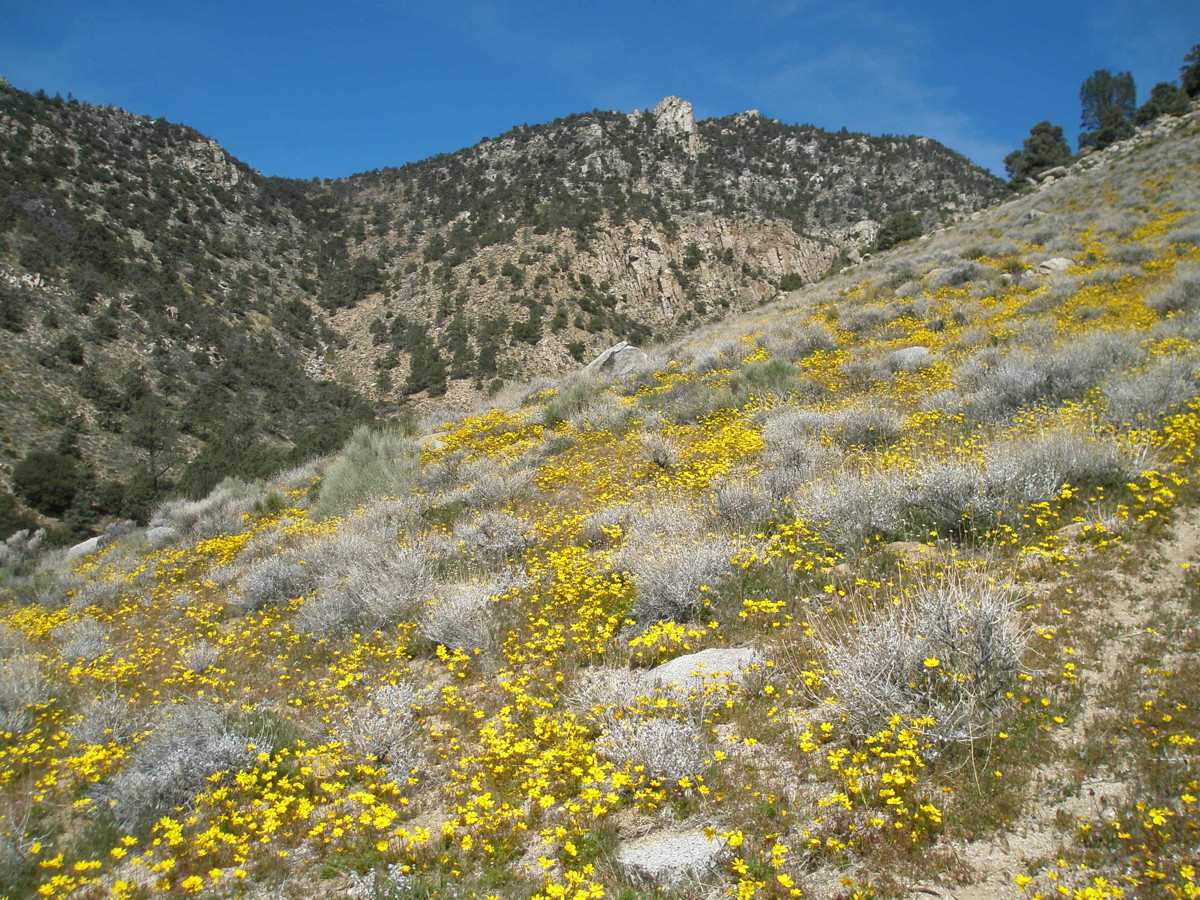
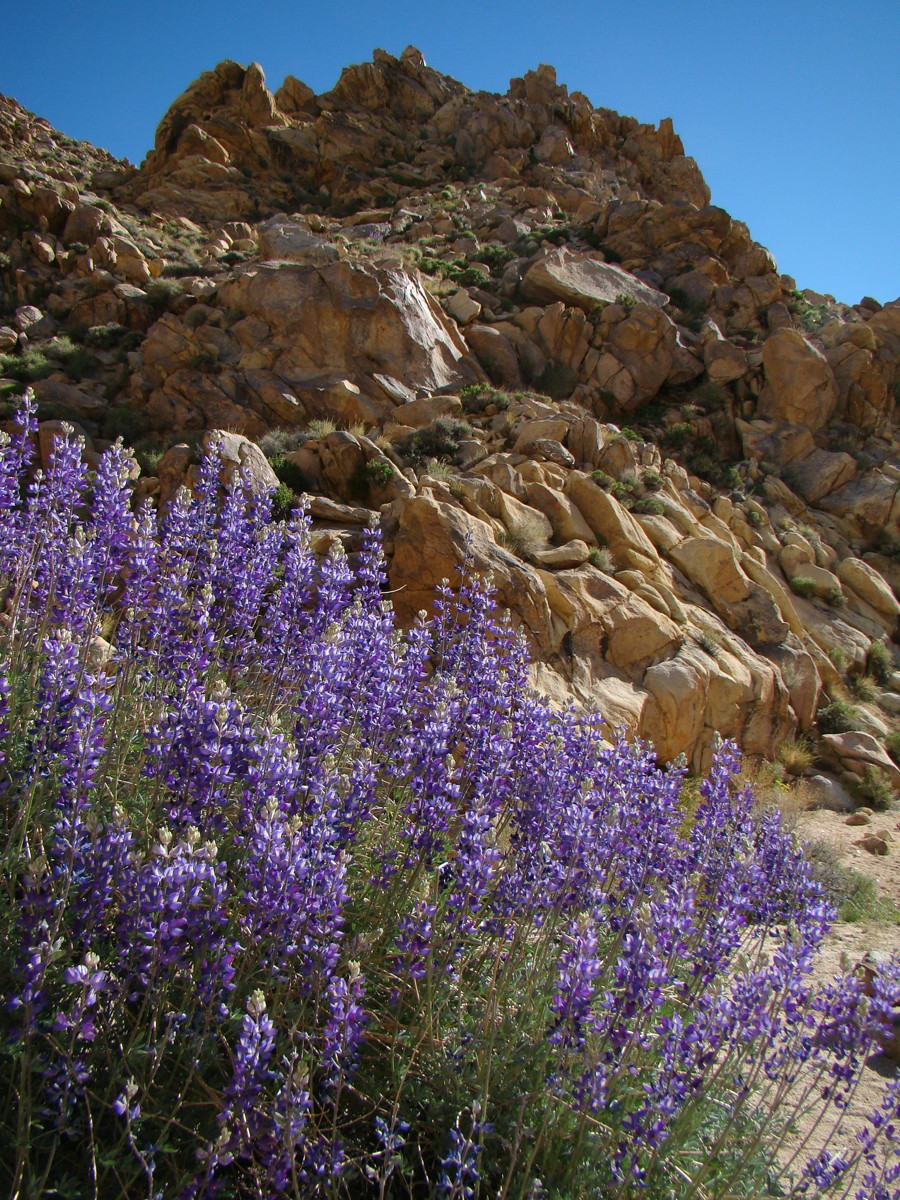
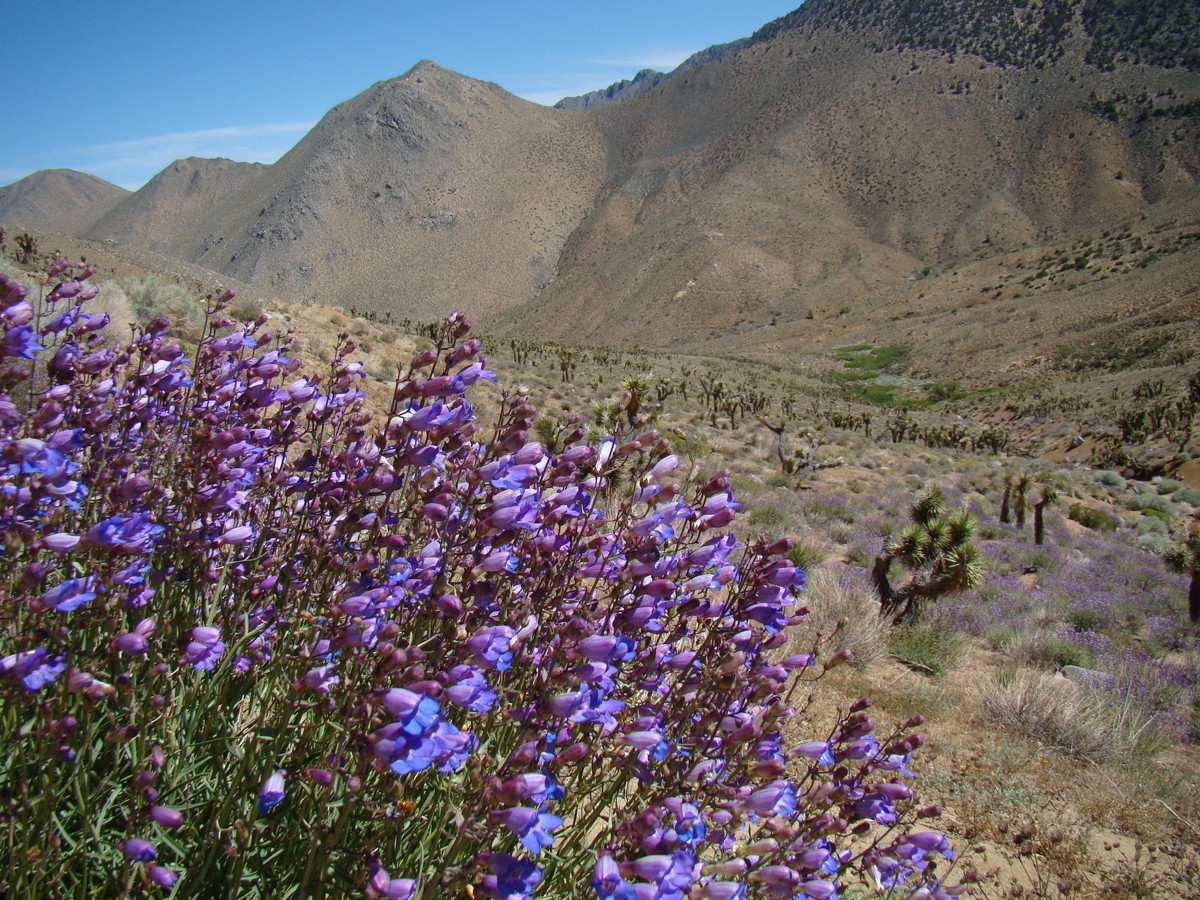
A few more wildflower photos to whet your appetite: California Poppy, Coreopsis, Desert Chicory, Grape Soda Lupine, Mojave Bush Penstemon, post-fire wildflowers in Indian Wells Canyon.

Desert Candle, El Paso Mountains
Photo by Kathy LaShure
News
First Place for Number of Rare Plant Occurrences in 2013 Rare Plant Treasure Hunt!

Our own Kathy LaShure, leader of the Creosote Ring Chapter and hunter of rare plants, was completely surprised with an award from the Rare Plant Treasure Hunt committee for documenting the most species of rare plants in the California Rare Plant Treasure Hunt. She and her team documented 15 occurrences of rare plants in their area winning her first place among botanists participating throughout the state. Her 3-year total is an impressive 72 populations recorded.
The Rare Plant Treasure Hunt is fun if sometimes arduous, but also very important to conservation of rare plant species. Among partners and supporters of the effort are US Bureau of Land Management, US Forest Service, National Forest Foundation, California Department of Fish and Wildlife, California State Parks and National Park Service. The program also receives support from Whale Tail grants, funded by proceeds from special license plates with the California Department of Motor Vehicles. More information is available at Rare Plant Treasure Hunt Project Background and Results.
Kathy is setting her eyes on some very enigmatic and elusive species for 2014 – Phacelia novenmillensi or 9-Mile Phacelia. She will have help from Erika Gardener, a Claremont College graduate student. Their field date is sometime between May 7 and 9 along the Pacific Crest Trail south of Walker Pass. Volunteers are welcome. Contact Kathy LaShure for more information at 760-377-4541.
Creosote Ring and the Red Jeepsters Win Again in 2012!
In last year's Rare Plant Treasure Hunt, The Red Jeepsters won 2nd place for their team, and also for Rich LaShure's great photo (see below).This time, the "intrepid" team came in 1st Place for both overall rare plants found and documented and for most trips led!
"The Creosote Ring subchapter of the Bristlecone Chapter submitted the most rare plant occurrences this year. Trip leader Kathy LaShure organized and led nine trips, documenting many rare plant occurrences from the southern Sierra Nevada. Although it’s a small subchapter, the Creosote Ring members filed in force this summer, and they had great success in finding and documenting their local rare plants. Thank you for your inspiring efforts!"
(from the CNPS Rare Plant Treasure Hunt Awards page)

Erigeron multiceps
A rare plant documented by the Creosote Ring subchapter
Photo by Kathy LaShure.
Kathy Says: "Yippee! The Creosote Ring won First Place honors this year! Our subchapter now has its own copy of Jepson II for field work & IDing."
The CNPS e-Newsletter has a different write-up about the Rare Plant Treasure Hunt & the 2012 awards. Here are some excerpts:
“Volunteers from the Creosote Ring subchapter and the Sierra Club visited Horseshoe Meadows, a high-elevation, easily accessible, subalpine meadow, as well as some of the surrounding passes and trails. We were fortunate to be joined by Tim Thomas, who has been studying the region's flora for 30 years. Despite the area's accessibility (a paved road makes the steep climb up the eastern slope of the Sierra to the trailhead), many exciting botanical finds awaited us. We found new and historical locations of Tulare rockcress (Boechera tularensis), field ivesia (Ivesia campetris), and Tulare campion (Silene aperta). Jean Dillingham, a new volunteer, was excited to find a very old occurrence of Sharmith's stickseed (Hackelia sharsmithii), a plant named after her friend Carl Sharsmith.”
And this:
“Individuals from many CNPS Chapters participated in the RPTH this year, but a few chapters led the way in organizing treasure hunts. This year's top chapter was the Creosote Ring subchapter of the Bristlecone Chapter. Kathy LaShure of Creosote Ring led many trips this year, some with other chapter members, and some with her two-person team, "The Red Jeepsters". They were able to find many new and historical occurrences of southern Sierra endemics this year, and their work will help with the proposed downranking of field ivesia (Ivesia campestris) from rank 1B to Rank 4.”
Thank you to everyone who participated in a Treasure Hunt this year.
Please come to our evening meeting on Wednesday, December 5th to hear more about the 2012 Rare Plant Treasure Hunt & see pictures of the plants we documented this past summer.

You Won't Find Plants by Looking Up!
Award-winning photo by Rich LaShure
The Red Jeepsters Score Rare Plants and Awards in the 2011 Rare Plant Treasure Hunt
The results are in for the 2011 Rare Plant Treasure Hunt, a state-wide collaboration between CNPS & the Department of Fish and Game to update data on rare plants and their associated habitats. The Red Jeepsters team (Kathy & Rich LaShure of Inyokern & the Creosote Ring subchapter) were declared Intrepid Treasure Hunters, the Second Place designation for team awards. Rich also received a Third Place for his photograph of the subchapter field trip to Osa Meadows in late August.
The LaShures began their adventures in the spring, exploring desert locations, with their first rare plant sighting on April 3, the Glamour Girl of local flora, Phacelia nashiana, Charlotte’s Phacelia. When the weather warmed, they moved to higher terrain, making a dozen trips to the Kern Plateau between June and the end of October. In all, documentation (both the required CNDDB form and supporting photographs) was submitted for 35 occurrences of 16 rare species. Of these 24 were new occurrences, 5 were updated recent occurrences, and 7 updated historic (older than 20 years) occurrences.
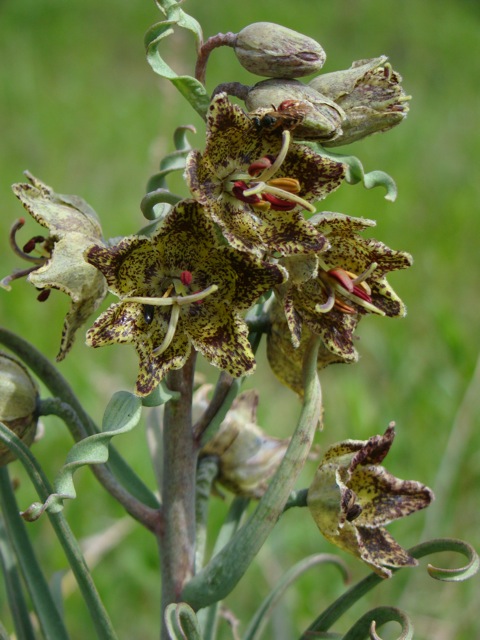
Fritillaria pinetorum, photo by Kathy LaShure
Kathy’s favorite was the dainty Phacelia orogenes, Mountain Phacelia, which occurred in carpets in several locations. Rich was fascinated by the bold stems of weirdly-marked Fritillaria pinetorum, Pine Fritillary, also found in more than one meadow. The most unusual find had to be Cordylanthus eremicus ssp. kernensis, Kern Plateau Bird's-beak, found almost as an after-thought on a late season expedition to see aspens in their golden fall garb along Jackass Creek. Another Bird’s-beak, Cordylanthus rigidus ssp. brevibracteatus, was the last find of the season on Oct. 28.
Plans are already being made for more expeditions next year. Kathy is now authorized to use the DFG’s RareFind database, making research easier. The Red Jeepsters hope to find additional populations of some of this year’s species, as well as targeting several new species and also looking in some locations near the Chimney Peak By-way at the southern edge of the Sierra Nevada range.
More Rare Plant Treasure Hunt Photos: Sidalcea multifida, Viola pinetorum ssp grisea and PDF of Kern Plateau Rare Plants of 2011.
News Archives
Ridgecrest Solar Power Project:
Cause for Celebration
An update on the Ridgecrest Solar Power Plant project
Can I have a round of applause please? Or three “Hip, Hip Hoorays”? Or just a loud “Yippee!”? Yes, it’s true the Ridgecrest Solar Power Plant project is officially history. In a letter dated Jan. 21, 2011 Solar Millennium withdrew its application for this project. In their own words “A review of the process and staff position on the project strongly suggests success is unlikely.” In other words the continuing CEC biological staff assertion that the site should not be disturbed was not going to change, even with a Mojave Ground Squirrel genetic connectivity study (which Solar Millennium proposed).
While those of us who opposed this ill-conceived project from a local and personal perspective can give ourselves some credit for standing up to Big Industry, we really owe the CEC staff a huge “Thank You.” Not only did the biological staff perform professionally, but the other CEC staff, those in charge of this project’s approval process, also carried out the proceedings in a thorough and thoughtful manner. Thanks should also go to the official Intervors: the Center for Biological Diversity (Ileene Anderson and Lisa Belenky); Desert Tortoise Council (Sid Silliman); Basin And Range Watch (Laura Cunningham and Kevin Emmerick); Western Watersheds Project (Michael J. Connor); Kerncrest Audubon (Brenda and Dan Burnett and Terri Middlemiss); California Unions for Reliable Energy (Elizabeth Klebaner). These groups and their representatives brought a wide array of expertise to the table, making sure that Solar Millennium did not slip anything over on us.
In celebration of this outcome my husband and I have spent three mornings in the past two weeks exploring the northern edge of the El Paso Mountains that overlook the site. Last Saturday we climbed the large volcanic hill just to the west of the site. While it was tempting to gaze downward at all the little green wildflower sprouts, the larger picture was more important. From the top we looked out over the El Paso Wash alluvial plain. My heart was full of gratitude that the fully functioning ecosystem below would remain a home for Desert Tortoises, Mojave Ground Squirrels, Desert Kit Foxes, LeConte’s Thrashers, Western Burrowing Owls and all the native plants that support them. It was a wonderful sight!
Kathy LaShure
Creosote Ring Leader
Hurray for the Little Guys!
Update on the Ridgecrest Solar Power Plant Project
I could also have titled this report “Creeping but Not Yet Dead” as the approval process for this ill-conceived project has slowed considerably since last spring. At that time, we thought recommendations would be made by both the BLM and the California Energy Commission (CEC) in time for final rulings by the end of this calendar year with construction to begin in 2011, if the project was approved.
However, once the CEC Staff Assessment/Draft Environmental Impact Report (SA/DEIR) was released in late March it became apparent that the CEC approval schedule would likely change (the BLM timetable was & remains different). This was due to the CEC staff’s findings that the biological resources of the proposed site could not be mitigated, nor could the visual impacts. This is the first time that CEC staff has made such an unequivocal finding for preserving a site and its intact, fully functioning ecosystem.
Their decision was based on the high number of Desert Tortoises of all ages and the functioning genetic corridor for Mojave Ground Squirrels. Of course neither of these species would thrive without high quality habitat. The Creosote Ring’s plant survey on April 17 showed just that. 23 participants helped to document the annual and perennial plant species found on the proposed RSPP site. 72 species from 25 plant families were observed, indicating a complex well-functioning ecosystem. Especially note-worthy were the existence of Winter Fat (Krascheninnikovia lanata) and Spiny Hop-Sage (Grayia spinosa), indicators of Mojave Ground Squirrel habitat and, perhaps more importantly, the occurrence of many preferred food plants for both juvenile and adult Desert Tortoises.
At the opening of the May 3-4 public workshops we were most pleased to hear Dick Anderson, CEC biologist, reference our plant list. Jane McEwen's terrific research documenting the preferred Desert Tortoise food plant observed bolstered CEC's position that this is a unique site. During the workshops Dave Hacker (CA Dept. Fish and Game) very strongly supported the need to preserve biological connectivity for the Mojave Ground Squirrel and Desert Tortoise as well. It was clear that the mitigation measures proposed by Solar Millennium do not meet the requirements of DFG & USFWS.
There are some other major issues with RSPP besides the biological and visual ones. The plan is to use trucked-in propane to keep the transfer fluid thin enough to work. We think that they have greatly underestimated how much propane they will need, as our fall-winter-spring air temps are lower than they have allowed for. This will increase the cost of generation, the carbon foot-print and traffic. Ridgecrest sits downwind of the site giving concerns about Valley Fever with the grading of such a large area (over 2000 acres). They claim mitigation will control 75% of the dust but that leaves 25% than can infect people. Valley Fever is not a fun disease.
Over the next weeks and months many excellent comment letters from both environmental organizations and private citizens were submitted to both the CEC & BLM (http://tinyurl.com/2dmkv2c). Most have supported the position that this project would irreparably alter a biological treasure and should not be built. I wrote a detailed letter for CNPS. The Naval Air Weapons Station, China Lake also wrote two letters expressing their considerable concerns.
Then on June 30, Solar Millennium requested a suspension of their application. They proposed conducting a 2-year survey to study connectivity issues for local populations of Mojave Ground Squirrels. This was approved by the CEC but the BLM approval process continues to move forward on its own timetable. After the July 8 mandatory status conference Solar Millennium realized that this request needed to be modified as it was perceived as “a complete halt to all activities.” Therefore on Aug. 8 Solar Millennium asked for the suspension to be changed to “a modification of … milestones.” We will have to wait to see what this really means.
However, since Solar Millennium has two other California sites (Blythe and Palen) moving through the approval process, they may be hoping that approval of one or both of them will give them additional monetary resources to put into Ridgecrest down the road. In the meantime, we should not be complacent, thinking that the little guys (Mojave Ground Squirrels) will do the heavy lifting for us. We must continue to monitor the CEC website for developments and maintain contacts with the excellent interveners. I am particularly grateful to two of them: Dan Burnett (Creosote Ring member and Kerncrest Audubon intervener) and Ileene Anderson (personal friend, Center for Biological Diversity biologist/intervener, and desert expert extraordinaire). My personal crash course in conservation work would have been far less successful without their generosity and dedication.
— Kathy LaShure
Thank you to everyone who submitted comments to the California Energy Commission (CEC) and BLM about the Ridgecrest Solar Power Project (RSPP).
Click here for a PDF file of the letter I sent, as Creosote Ring Coordinator, to both the CEC & BLM. The plant list generated by the Creosote Ring April field trip to the RSPP site is available here. If you have not been reading the comment letters as they are posted on the CEC website here’s the link: http://tinyurl.com/26nhrwp. The latest posting was from the Naval Air Warfare Center, towards the bottom of the list, with points that no one else could make.
As for where we are in the permitting process, this site was taken off fast-track schedule in May, which means that the original timetable was scrapped. A new schedule will not be set until late September, after the publication of the Revised Staff Assessment. However, two additional biological workshops are to be scheduled, one still in June & another in July. There are no precise dates for these yet. As I will be out of the loop for the next several weeks due to family concerns, please check here http://tinyurl.com/23zo4tk for schedule postings.
Again, if you are not on Don & Judy Decker's email list for updates on Ridgecrest Solar Power Project, you may wish to contact Don ddecker@ridgenet.net. The Deckers have been providing excellent summaries of all the action.
Click for Album
(opens in new window)
To the left is an online photo album showing the area of 2002 acres that will be bulldozed and scraped bare if the proposed Ridgecrest Solar Power Project is approved. The photos were taken between February and April, 2010, just a brief sample of the scenery and flora that will be competely and irreplaceably destroyed. Many of these spring flowers are food plants for the desert tortoise which still live here, as well kit fox, burrowing owl, lizards, and snakes, signs of which are evident is one takes the time to look.
Below is a field trip report for the area for more information.
If you want to read up on the permitting process, here is the link to the CEC site for RSPP:
http://www.energy.ca.gov/sitingcases/solar_millennium_ridgecrest/index.html
Kathy LaShure,
Creosote Ring Leader
Field Trip Report: El Paso Wash, April 17, 2010
It’s been a late and balky spring in the Indian Wells Valley. But 23 individuals showed up on a glorious (i.e. calm wind/warm temperature) morning to explore the El Paso Wash drainage southwest of Ridgecrest. Solar Millennium, LLC has proposed to use nearly 4000 acres of BLM land there for a 250-megawatt solar thermal electric power plant. The project site lies just northeast of the El Paso Mountains and is bisected by Brown Road (old Highway 395) forming a north field and a south field. The first iteration of the plan had the facility partially sited in the El Paso Wash proper. That was changed after the first public meetings in Dec. 2009. Now it is sited on both sides of the Wash. But the entire site is in an historic drainage, as evidenced by the tumbled appearance of the rocks there.
The original purpose of the field trip, as planned in January, was to informally survey the flora of this area. No rare plants were known to occur there, but that may be because no one had looked in the right place or at the right time. However, fauna there has been well-documented. The most significant species are Desert Tortoise, Mojave Ground Squirrel, Desert Kit Fox, Burrowing Owl, LeConte’s Thrasher, and Loggerhead Shrike. Of course theses animals would not be present without the specific plant resources needed for food and shelter.
Once CNPS hired Amber Swanson as Rare Plant Treasure Hunt coordinator for the Mojave Desert, she agreed to trek north from her Claremont home-base and help us survey the flora. She provided a list of specific rare plants that have been known to occur not far away in other El Paso Mountains locations. So we kept an eye out for them as well. We also had other participants from Southern California.
The trip’s participants amiably split into two survey groups. Jane McEwen and Judy Breitenstein led the exploration of the north field which lies to the east of the broad, braided El Paso Wash. The second group tackled the south field on the west side of the drainage and was led by Amber Swanson and Kathy LaShure. We did not hope to cover the entire large footprint of the proposed solar site, but did the best we could in a single morning.
No rare plants were found by either group. But the combined plant list has 70 species in 25 families, indicating a diverse flora. Many known Desert Tortoise preferred food plants were documented. If you would like a copy of the plant list please contact Kathy LaShure, desert_encelia@verizon.net.
The Draft EIR/Staff Assessment was released on April 9 and the BLM comment period extends for 90 days from that date. Information about the DEIR can be accessed here: http://tinyurl.com/2cugk79. The Creosote Ring subchapter is working with Greg Suba, CNPS State Conservation Director, to be sure that our response to this poorly sited facility is as effective as possible.
— Kathy LaShure
Wildflower Alert!
4/16/2010: A sub-chapter member reports there are amazing blooms in Kelso Valley: take Hwy 178 to Kelso Creek Rd and keep going south til you see the orange and purple on the slopes to the west. There is also a slope full of Baby Blue eyes.
Click on the images below for larger pictures.


Meeting Report
Our February evening program was on Wednesday, February 3 at 7 PM at the Maturango Museum. First we talked briefly about our participation the Rare Plant Treasure Hunt being organized by the State CNPS office and chose some dates & locations for 2010 field trips. Then CR member Jane McEwen presented Desert Microbial Life Matters:
Jane shared preliminary results of her investigation of microbial mats growing in the wash in Poison Canyon illustrated with her photographs as well as with photomicrographs taken by Wayne Lanier, PhD. These microbial mats are highly photosynthetic, as evidenced from the prolific production oxygen bubbles. The small spring-fed stream in Poison Canyon was covered with colorful masses of microbes up until the recent rainstorms. Now that the flood has washed away almost all signs of the microbial mats, Jane plans to study the recovery of the microbial community over the next year.
She also presented photographs, photomicrographs and samples of soil crust collected northeast of Searles Lake. Cyanobacterial filaments bind soil particles into a crust, referred to as cryptobiotic or microbiotic soil crusts. These soil crusts reduce soil loss from wind and water erosion and also provide a living mulch that retains soil moisture. The cyanobacteria in the soil crust are photosynthetically active when enough moisture is present. They also fix nitrogen from the atmosphere making it available for plant growth in the desert soils, which other wise are low in nitrogen.
For those of you interested in more information on microbial life such as those found in salt marshes and soil crusts see Wayne Lanier's archived website http://www.hikingwithafieldmicroscope.com/ and Wayne Lanier's and his colleague Cris Benton's website: http://ostro.ced.berkeley.edu/~crisr/he/.
Field Trip Suggestions
For current information about our activities, please contact Kathy LaShure, subchapter coordinator: (desert_encelia@verizon.net or 760-377-4541). We have an email notification list for current activities. Also, be sure and check the main Bristlecone Chapter Events page for events a little farther north!

Butterfly Mariposa Lily, photo by Kathy LaShure
Here are some more suggestions for native plant activities now and over the summer months:
Last Friday (May 27), Rich & I hiked the Flynn Creek trail that starts at McNally's above Kernville. You cross the roaring Kern River on the bridge & turn south. Above the split with the Tobias Creek Trail (about 1-1.25 miles in) there are thousands of Calochortus venustus (Butterfly Mariposa Lily), more than I've seen anywhere else. The bloom should still be good this weekend as there were lots of buds.
On the drive west on Hwy 178 just past the Canebrake Reserve (large new sign), on the south side of the road there is a magnificent population of Mojave Bush Penstemon (Penstemon incertus) just coming into full bloom (& there is room on that side of the road to safely pull off & park for photos).
If you don't want to drive that far, Paul Decker shared the location of a huge colony of Sand Plant (Desert Christmas Tree) Pholisma arenaria here in Inyokern. Here are some of his photos of those strange plants:
[Click on the images for larger pictures]

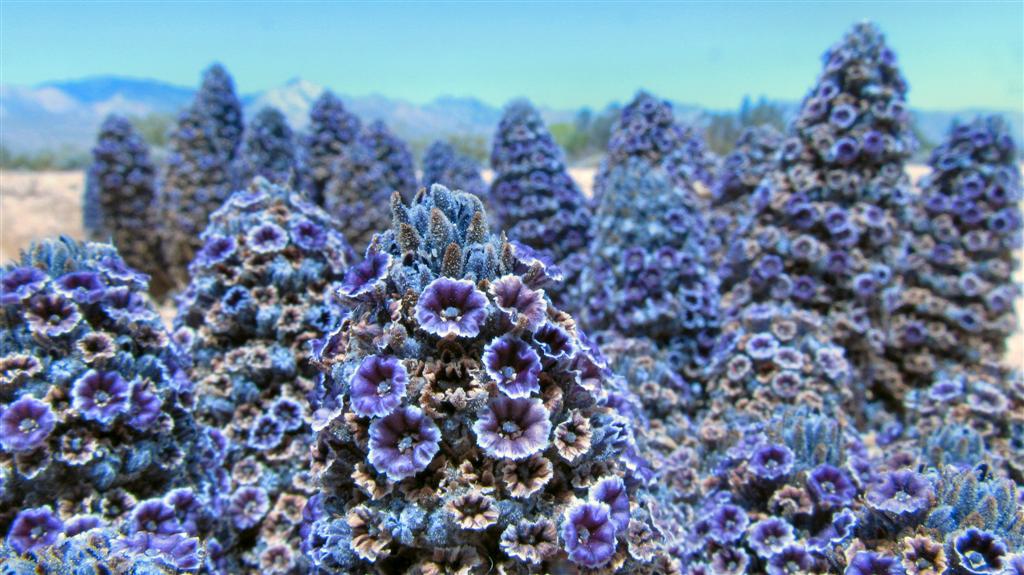

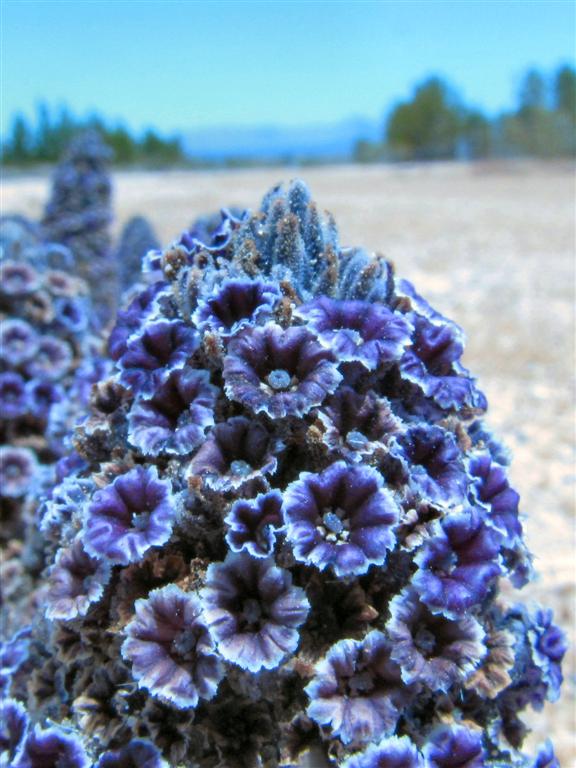
Finally, if you aren't up to getting out, here are 3 websites with lots of interesting information & wonderful pictures:
As always, I hope each of you has a terrific summer with close encounters of the native plant kind!
Wildflower Guides and Creosote Information

Quite possibly the oldest living things (even older than the ancient Bristlecone Pines), Creosote rings are formed by cloning as new growth sprouts up around the perimeter of the original shrub. This is the oldest known Creosote ring, "King Clone," which is located south of us in the Mojave Chapter's territory.
Guides to local wildflower hotspots and Mojave shrubs:
Each brochure also includes when to go, how to get there & a short description of the most noteworthy wildflowers to be seen. Please click on any link for a printable PDF of these guides.
Information about our sub-chapter namesake, the Creosote Bush:
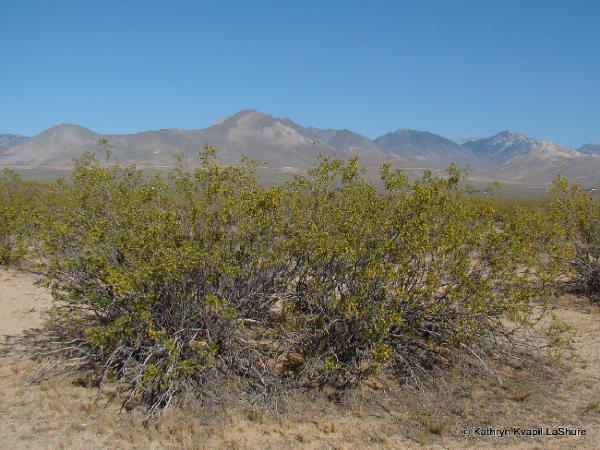
Creosote Ring with Owens Peak in the background
Photo by Kathy LaShure